This month, we're featuring members of our SABER Scholars-in-Training community who were acknowledged for their talks or posters at our annual national meeting in July.
Our fourth "Human of DBER" for September is Ijeoma Nwokolo, a PhD Student at Western Michigan University and 2026 recipient of the Best Graduate Poster Award.
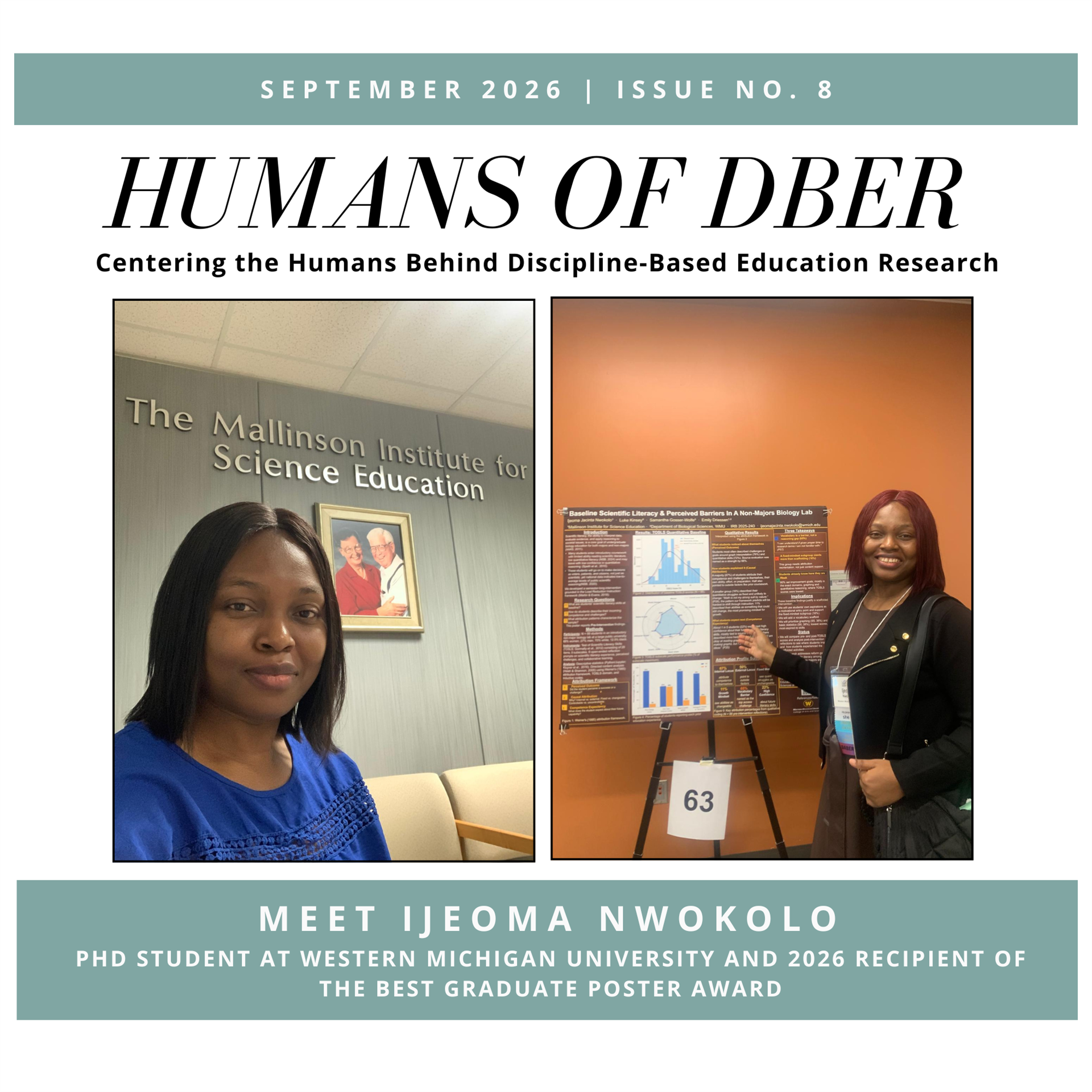
My path to biology education research was anything but linear, beginning with a series of detours that eventually converged. I began my academic journey in applied biochemistry in Nigeria. I later pursued graduate research in environmental toxicology, investigating the effects of crude oil contamination on aquatic organisms in the Niger Delta. An MBA followed, and then a master’s in data science and artificial intelligence in the United Kingdom. During my AI research, I developed machine-learning models to identify students at risk of struggling academically before they fell through the cracks. But somewhere in the process of teaching a machine to recognize patterns in student data, I realized that the harder, more interesting question wasn’t whether an algorithm could predict a struggling student; it was whether we were teaching students, and ourselves, to reason with data at all. That question changed the direction of my career. It brought me to the Mallinson Institute for Science Education at Western Michigan University, where I now study scientific, data, and AI literacy in undergraduate life science education. My work brings together the different worlds I have inhabited: biology, environmental toxicology, data science, teaching, and education research, to help students become more confident and capable consumers and users of scientific information.
What I love most about DBER is that it allows all the seemingly disconnected pieces of my journey to finally make sense because it situates me at the intersection of everything I once thought were separate careers. I get to build instructional tools grounded in real classroom data, teach non-majors biology, and mentor undergraduates learning to ask their first research questions, the same kind of question I once asked as a biochemist wondering what the numbers on a printout actually meant. My journey has taught me that a career does not have to be linear to be meaningful; sometimes the detours give you the perspective you need to ask questions that you would not have otherwise considered. My experiences in biochemistry, toxicology, business, AI, and education research have all taught me the same lesson from different angles: data only matters once someone can read it. My advice to aspiring DBER researchers, especially those coming from another discipline, is, "Do not apologize for your detour.” The skills, experiences, and questions you developed along the way may become the very things that make your contribution to the field unique. My first SABER conference in 2026, where I was honored with the Graduate Poster Award, made this lesson even more meaningful. I came to SABER to share my research and left feeling that I had found a community of people who are asking the kinds of questions I care deeply about.
If you have a colleague in DBER that you'd like to nominate to be the next Human of DBER, please submit your nomination here! Nominations are welcome for members of the SABER and biology education research community, including undergraduate and graduate students, postdoctoral scholars, faculty, staff, educators, and community partners who contribute to biology education, research, or inclusive STEM initiatives.