
Undergraduate and Graduate Student Poster Awards
The Poster Awards celebrate the outstanding work of graduate and undergraduate students at the Annual Meeting. Graduate and undergraduate students presenting posters at the SABER Annual Meeting are considered for the Poster Awards. Presenting students are sent an email in late May/Early June with an opportunity to opt out, as well as view the judging rubric. Participating students submit a pdf of their poster by the deadline (~ one week prior to the conference) and are pre-screened using a rubric by the Awards Committee. The ten undergraduate and ten graduate student posters with the top pre-screened scores are visited in-person during the evening poster sessions. Additional scoring on the presentation determines the winners, and is included on the rubric. Award winners are announced at the business meeting on the last day of the conference, and a monetary prize is awarded.
2026 Award Winners
Graduate Poster Award sponsored by
Ijeoma Nwokolo "Baseline Scientific Literacy, Quantitative Reasoning, and Perceived Barriers among Non-Majors in an Introductory Biology Laboratory" Other authors: Emily Driessen; Luke Kinsey; Samantha Gosser-Wolfe |  Travis Ray "Are we Preparing Biology Students to Talk About Vaccines? Exploring Student Perspectives" Other Authors: Barnes, Elizabeth |

2025 Award Winners
J Hayes "Exploring Christian undergraduate biology students as potential boundary spanners about climate change" |
Jynx Pigart "Undergraduates in STEM fields and women report worse mental health than non-STEM majors and men" |


2024 Award Winners
Faith Frings "Community college transfer students’ perceptions of supports and barriers to persistence in their major at a four-year institution" | 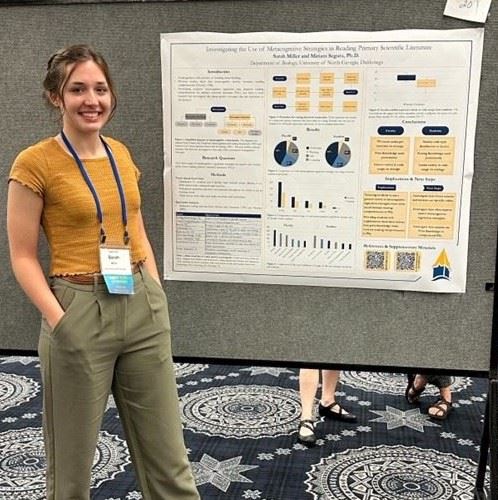 Sarah Miller University of North Georgia "Investigating the Use of Metacognitive Strategies in Reading Primary Scientific Literature" |

2023 Award Winners
Marie Ramirez "Undergraduate Research Experiences: Exploring Student Science Identity and Possible Self Formation" |
Rachel Youngblood "Exposure to counterstereotypical scientific role models impacts how students relate to scientists" |

